
Home / Gift guides / Photo book story
Photo Book TipsPhoto Book Story: How to Write the Story of Your Book
A good photo book story is not a long essay. It is a clear shape (a beginning, a middle, an end), a few well-placed words, and photos that are given room to speak. This guide shows you how to choose that shape and write every piece of text, with a worked example.

Most people make a photo book the same way: dump 300 pictures in date order, add a caption like "Fun day!" under a few, and call it done. The result is pleasant, but it rarely moves anyone. The books that make a mother cry or a husband go quiet have something else going on. They have a photo book story.
A photo book story does not need a plot twist or fine writing. It needs a reason for the order of the pages, a few honest sentences, and the discipline to leave most photos out. If you have ever struggled with what to say, start with our guide on what to write in a memory book for message ideas, then come back here for the bigger structure.
Below you will find four narrative arcs, tips for openings, chapter titles and captions, and a full worked example for a 25th anniversary. It is written for ordinary families, not professional writers.
If you would rather not do the layout yourself, personalised photo books from Ragnar Studio's start from ₹799 / $19: you send your photos and your story notes on WhatsApp, the studio designs the pages, you approve them, and then the book is professionally printed. Hindi and English are both supported.
What a photo book story actually is
A photo book story is the thread that makes page 14 follow page 13 for a reason. It answers three questions: who is this book about, what changes or stays the same between the first page and the last, and how should the reader feel at the end?
You are not writing a novel. Think of it more like telling a friend about a trip over chai. You start somewhere, you pick the moments that matter, you skip the boring parts, and you end on something that lands.
Three things separate a book with a story from a book that is only a collection:
- A shape. The pages move from somewhere to somewhere, instead of landing randomly.
- A voice. The words sound like you (or like the person giving the gift), not like a greeting card.
- Restraint. Fifty strong photos with a clear story beat two hundred photos with none.
Start with the reader and one sentence
Before choosing photos, decide who will open the book and what you want them to feel. A book for a grandmother who will turn the pages slowly with her glasses on needs a different story from one for a husband who will flip through it on a Sunday morning.
Then write one sentence that sums up the book. Not a title yet, just the truth of it. A few examples:
- "Twenty-five years of the two of us, and how the house filled up around us."
- "Everything Aarav did in his first year, in the order it happened."
- "Seven days in Kerala when we finally switched our phones off."
Every time you hesitate over a photo or a caption, ask: does it serve this sentence? If not, it can wait for another book. This single habit does more for the finished book than any layout trick.
Choose a narrative arc for your photo book story
An arc is simply the order in which you tell things. There are four that work for nearly every occasion. Pick one before you arrange a single page.
| Arc | How it flows | Best for |
|---|---|---|
| Chronological | Oldest to newest, with a clear start and finish | Baby's first year, a trip, a wedding, a milestone birthday |
| Themed | Grouped by idea, such as food, faces, hands, places | Friends, a long marriage, a family with many years of photos |
| Letter | Written as one long note to the reader, with photos as illustrations | Parents, partners, a farewell, a thank-you |
| Day in the life | One ordinary day, morning to night | Toddlers, pets, grandparents, a home or a small business |
Chronological
The safest choice and often the right one. Its strength is that anyone can follow it. Its danger is that it becomes a diary: every month gets the same weight. Cut ruthlessly so that the big moments breathe. A baby's first smile deserves a full page; the fourth identical cot photo does not.
Themed
When you have twenty years of pictures, dates stop being helpful. Chapters such as "Our kitchen", "Our road trips" and "The kids at every age" let you mix decades. The thread is the theme itself, so the ending needs extra care: finish with the chapter that feels like the heart of the relationship.
Letter
This is the most personal arc. You write directly to "you", and the photos show what you are describing. It pairs well with a photo book for parents or a partner, because the words can say what face-to-face conversation never does.
Day in the life
Pick one ordinary day, or a composite of one, and follow it: chai, school bag, the dog at the door, dinner, lights out. It works because it turns routine into something precious.
Write a strong opening: the title page and first spread
Readers decide within the first two spreads whether the book is going to be lazy or loved. Give them a reason to care.
- The title. Short and specific beats clever. "Mehra Family, 2001 to 2026" is better than "Memories Forever".
- A dedication line. One sentence, for example "For Papa, who taught us to keep going."
- An opening note (50 to 120 words). Say why the book exists. When did you think of it? Who helped? What do you hope they feel?
Here is a sample opening note for a book for a mother who has everything:
Maa, you never keep photos of yourself, so we collected them from every phone in the family. This book is the first time you appear on every page. Read it slowly. Start with page one.
Notice what it does: it names the reader, hints at the idea of the book, and ends with an instruction. Our photo book caption ideas page has more openers if you want to compare styles.
Have the photos but not the words? Share your photos and a few notes on WhatsApp, and the studio designs the pages for you to approve. See personalised photo books and start with your photo book story.
Chapter titles and dividers that carry the story
Chapter pages are the quiet heroes of a good book. They give the reader a place to breathe and tell them where they are. A 40-page book usually does well with three to six chapters; a very short book may need none.
Good chapter titles are concrete and short. Compare:
- Weak: "Happy Times", "Beautiful Memories", "Fun"
- Strong: "The Year We Moved to Pune", "Monsoon Mornings", "Before the Wedding", "Nani's House"
A useful test: could the chapter title appear in someone else's book? If yes, it is too generic. Add a name, a place or a year.
Under each title, add one line of context in a smaller size: a date range, a location, or a single sentence of setting. Do not repeat what the photos show. Tell the reader what they cannot see: why you were there, who held the camera, what happened right after.
Short captions versus long text
Every page asks the same question: does this photo need words at all? Many do not. A book is often strongest when the biggest, best pictures are left bare and the words appear exactly where the picture alone is not enough.
| Type of text | Length | Use it when |
|---|---|---|
| Label | 2 to 5 words | A name, a place, a date: "Haridwar, March 2024" |
| Caption | 1 sentence | You want to add a feeling, a joke or the thing outside the frame |
| Short story | 40 to 80 words | A turning point, a funny incident, a person who deserves a paragraph |
| Letter page | 100 to 200 words | The opening, the ending, or one emotional peak |
A practical rule: use labels on most pages, a caption on about a third, a short story on a handful, and a full letter page no more than two or three times. If every page has a paragraph, the paragraphs stop mattering.
Keep the text easy to read. Dark text on a plain, light area of the page works better than text laid over a busy part of the photo. For more help with placement and white space, see our guide to photo book layout and design tips.
Find your voice: how the words should sound
The easiest way to find the voice for your writing is to imagine saying it aloud to the person. Then write down what you said, and trim.
- Use "I" and "we". "We got lost for two hours and ended up with the best dosa of the trip" beats "A delightful culinary detour occurred."
- Use real names and nicknames. If the family calls her Chhoti, write Chhoti.
- Mix languages if that is how you speak. Hindi and English together is perfectly natural for many Indian families. Ragnar Studio's supports both languages in the book.
- Be specific, not grand. "You always carried extra biscuits for the dog" tells more than "You were always so caring."
Avoid stock phrases such as "cherished memories" and "time flies". If you catch yourself writing one, ask what actually happened and write that instead.
Using quotes, dates and places
Three small devices lift a book from nice to specific.
Real quotes
A line someone actually said is worth ten lines you invent. Think of the toddler's first sentence, a grandfather's favourite saying, or a message from a friend. Write it exactly as spoken, in quotation marks, and say who said it.
Dates
Dates anchor the memory and help future readers. You do not need to put one on every page. Use them at chapter starts and for milestones. If you are unsure of the exact day, the month and year are fine.
Places
Name the place, then add one detail that makes it real: the smell, the sound, the food. Our travel photo book ideas and captions page has examples of how to do this without sounding like a brochure.
Balancing text and photos across the book
The balance is easiest to judge if you plan the book as a rhythm instead of a list. A typical flow across spreads looks like this:
- Opening spread: title, dedication, opening note, one strong photo.
- Establishing pages: a few wider photos that set the scene, with labels only.
- Story pages: a mix of full-bleed photos and small groups of three to four, with a caption on some.
- Breathing pages: a single large photo with no text, to let the reader pause.
- Peak page: one short story or letter page, often with a smaller photo beside it.
- Closing spread: the last photo and a final line, or a blank page for the reader to write on.
If you are unsure how many photos to include, our guide on how many photos in a photo book explains how page count and photos per page work together. As a general rule, aim for fewer photos than you think, and choose them with the help of how to choose photos for a memory book.
Finally, vary the pace. Three busy collage pages in a row tire the eye. Follow a dense page with a calm one, and your book will feel like a good film rather than a slideshow.
Worked example: a 25th anniversary photo book story
Here is how the ideas come together. Imagine a daughter making a gift for her parents' 25th anniversary. She picks the themed arc with a letter opening, and sums up the book in one sentence: "Twenty-five years of Mummy and Papa, told through the places we all gathered."
| Pages | Chapter | Text plan |
|---|---|---|
| 1 to 2 | Title and opening note | "Sharma Family, 2001 to 2026", dedication, 90-word letter from the daughter |
| 3 to 8 | The Wedding Year | Labels with dates, one 50-word story about Papa forgetting the garlands |
| 9 to 16 | Our First Flat | Short captions, one real quote from Mummy about the leaking tap |
| 17 to 26 | Round the Kitchen Table | Mostly photos, a few one-line captions, two blank-text pages |
| 27 to 34 | Road Trips | Place labels, a funny caption per trip, a map-style page |
| 35 to 38 | Now | Large recent portraits, a 120-word closing letter |
| 39 to 40 | Last page | "Here's to the next 25." and a blank space for signatures |
Here are samples of the text she might write.
Label: "Dehradun, December 2001"
Caption: "Papa swears he knew the way. Mummy kept the map."
Closing letter excerpt: "You never gave a speech about love. You showed it by packing two tiffins every morning for twenty-five years. This book is a small thank you for every one of them."
Notice that none of these lines are poetic. They are specific, kind and short. That is what makes this photo book story work. For occasion-specific ideas, see the 25th anniversary photo book page.
Common mistakes and a final checklist
These slips weaken any photo book story:
- No clear start. The first page is a random group photo with no context.
- Too much text. Long paragraphs on every page, set in small type.
- Repeating the picture. Captions that say "Us at the beach" under a photo of a beach.
- Typos. Names misspelt, wrong years. Read every page aloud before approving.
- Photo quality. Blurry or heavily compressed pictures are hard to rescue in print. On WhatsApp, a normal photo send is compressed, so sending important originals as a document is commonly recommended. Ask the studio what format works best.
Before you send the book for printing, run through this checklist:
- Can I say what this photo book story is about in one sentence?
- Did I choose an arc and stick with it?
- Is there an opening note and a closing line?
- Do chapter titles name a person, place or year?
- Are there breathing pages with no text?
- Have two people proofread names, dates and places?
If you want help turning your notes into pages, how to make a photo book from phone photos and WhatsApp walks through the process step by step.
Frequently asked questions
What is a photo book story?
A photo book story is the structure and the words that turn a pile of photos into something with a beginning, middle and end. It usually includes an opening note, chapter titles, short captions and a closing line. It does not need to be long or literary.
How do I start writing a photo book story?
Begin by deciding who will read it and writing one sentence that sums up the book. Then choose a narrative arc, such as chronological or themed, before you arrange any pages. Writing the opening note last is often easier.
How much text should a photo book have?
Less than most people expect. Use labels on most pages, a one-sentence caption on about a third, and a longer paragraph on only a handful of pages. Leave several pages with photos alone.
Which narrative arc is best for a photo book story?
Chronological suits babies, trips and weddings. A themed arc works when you have many years of photos, a letter arc suits parents and partners, and a day-in-the-life arc is lovely for children and pets. Pick the one that fits the reader, not the photos.
How long should a photo book story caption be?
Most captions work best at one sentence, and labels at two to five words. Save 40 to 80 words for a few key moments, and 100 to 200 words for the opening or closing letter only.
Can I write my photo book story in Hindi or a mix of languages?
Yes. Many families write in Hindi, English or a mix, because that is how they speak. Ragnar Studio's supports both Hindi and English, so you can send your text on WhatsApp in the language you prefer.
Do I need to write the whole photo book story myself?
No. Send your photos and rough notes on WhatsApp, and the studio designs the pages. You review and approve them before the book is printed. Photo books from Ragnar Studio's start from ₹799, and the studio can tell you what else is included when you message.
How do I make my photo book story emotional without being cheesy?
Be specific. Real names, real quotes and small details such as the biscuits in a handbag feel more moving than big phrases like cherished memories. Keep sentences short and let the photos carry the rest.
A strong photo book story is simple: one reader in mind, one clear arc, honest words and plenty of space for the photos. Start with your one-sentence summary today, then send your photos to the studio on WhatsApp at +91 92865 18510 or browse personalised photo books for your occasion.
Start your book
Tell us your story.
Build your enquiry here, then send it in WhatsApp. We’ll discuss the design, final price and delivery before you order.
- Choose a page count and occasion
- Add as much or as little story as you like
- Send photos in the same WhatsApp chat
- 1Book
- 2For
- 3Story
- 4Photos
- 5You
- 6Review
To create a book, contact us on WhatsApp or email info@ragnarstudio.com. The step-by-step form needs JavaScript.
Almost there
Your enquiry is ready to send.
Open WhatsApp, review the message and press Send. Share your selected photos in the same chat.
Keep reading.
More ideas and guides from Ragnar Studio's.
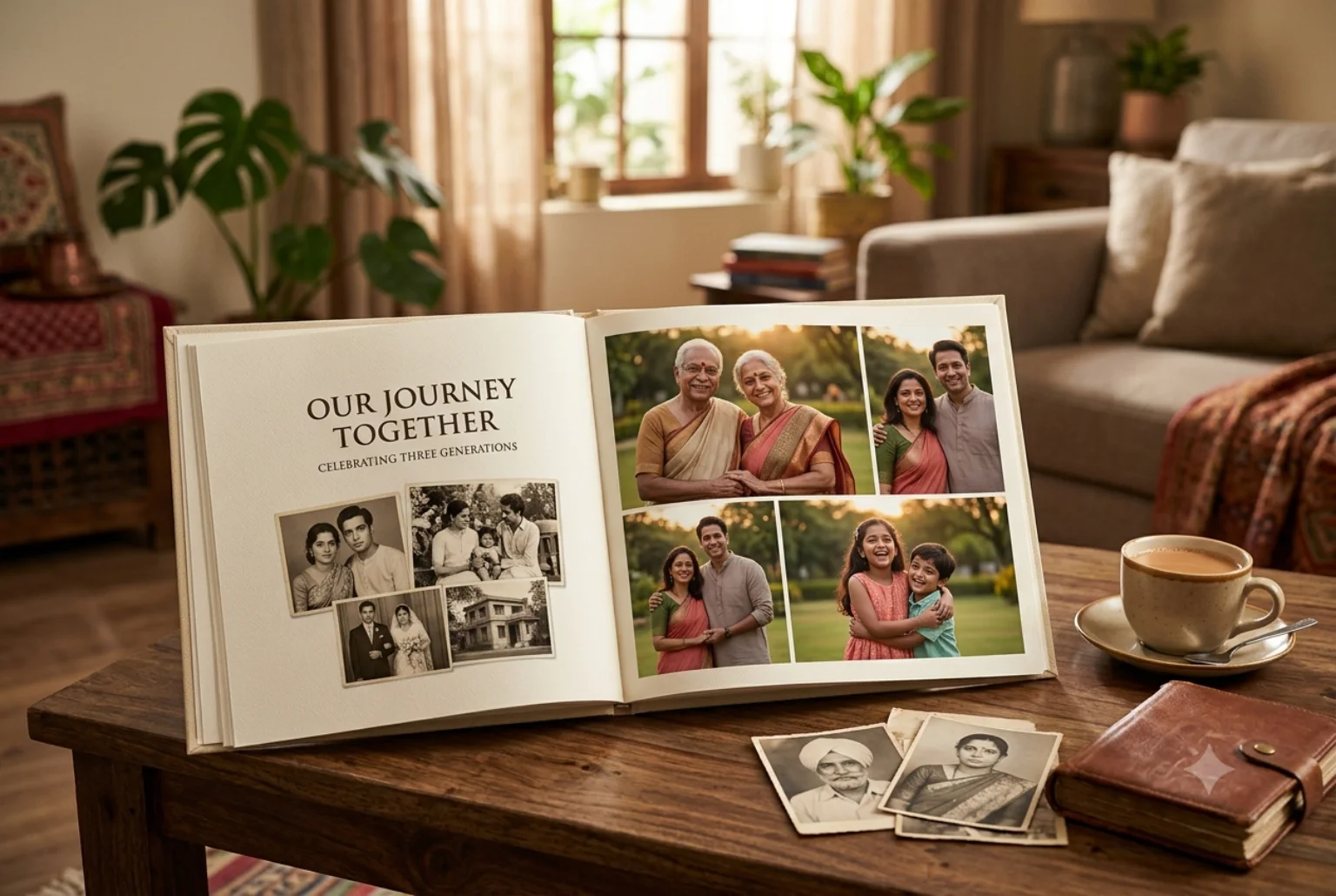 Photo book guideFamily Photo Book Ideas, Captions and LayoutsIdeas and caption lines for a family photo book that covers several generations without feeling crowded.Read the guide →
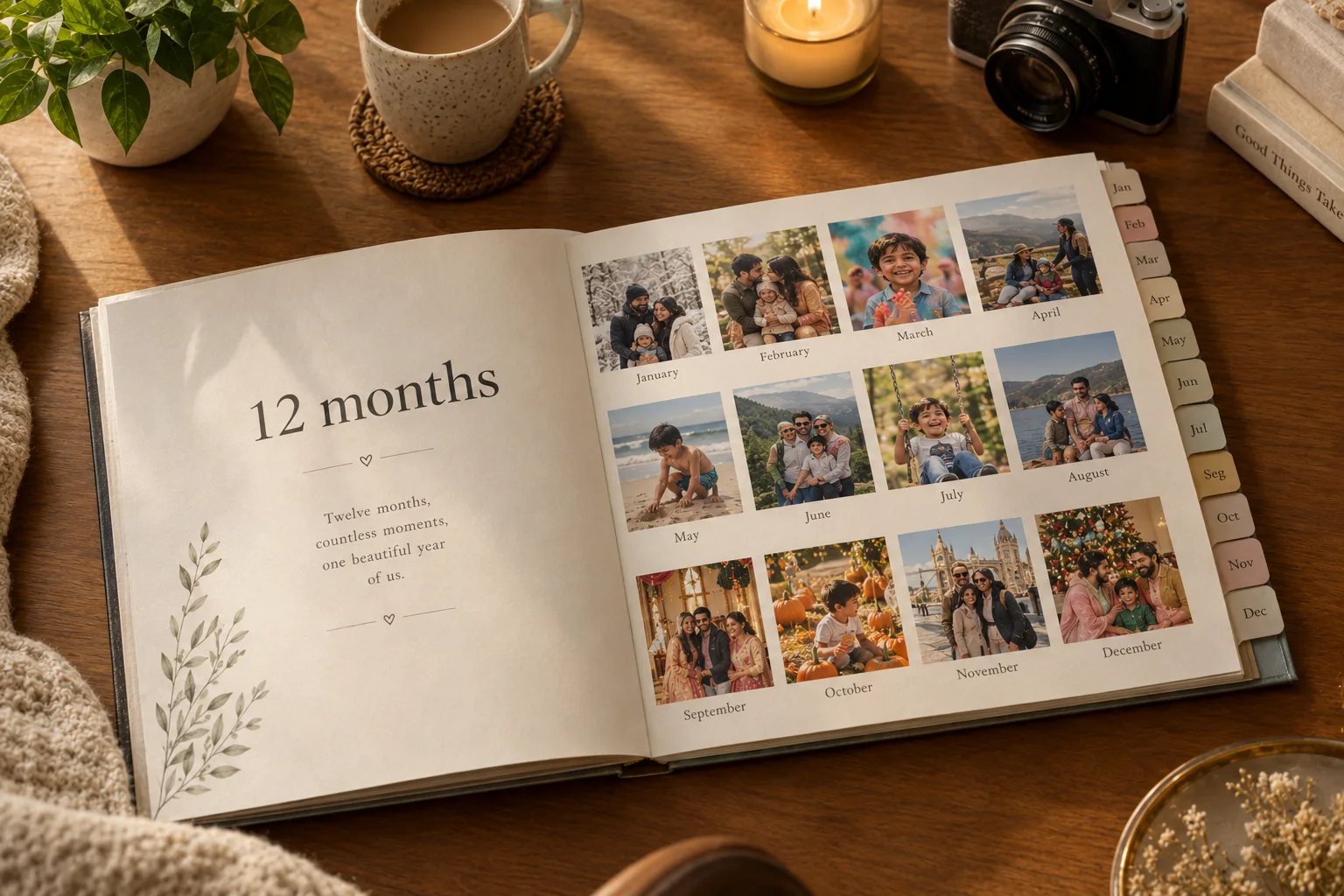 Photo book guideYear in Review Photo Book: A Month-by-Month GuideTurn twelve months of phone photos into a clear year-in-review book with chapters, captions and a closing note.Read the guide →
 Photo book guide30 Photo Book Ideas for Couples: Themes, Layouts and CaptionsPage ideas, themes and captions for couples who want a book that feels personal and romantic, not generic.Read the guide →
Turn your photos into a book worth keeping.
Share your photographs and a few lines. The studio will design the pages, you approve them, and it is professionally printed. Books start at ₹799 / $19.