
Home / Blog / Website Design Process: Every Step From Brief to Launch
Web DevelopmentWebsite Design Process: Every Step From Brief to Launch
Here is how a small business website really gets made, stage by stage, with what you must supply and where projects usually get stuck.
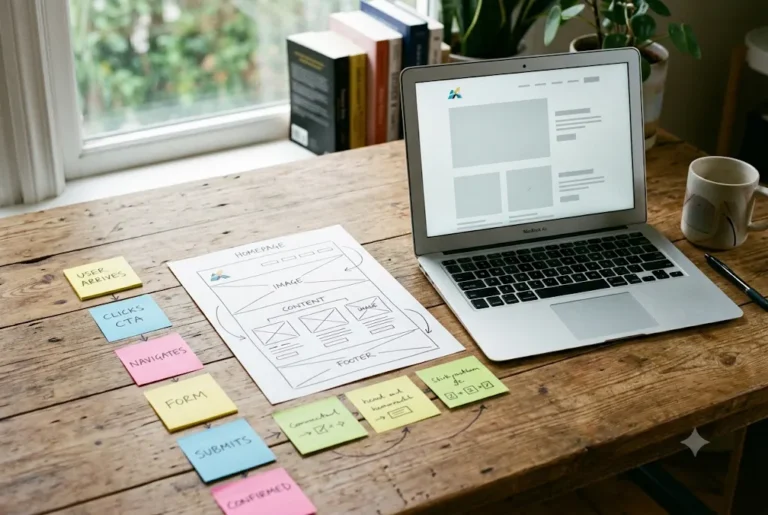
The website design process is the set of steps that takes a small business from "we need a website" to a live site that brings in enquiries. Most owners only see the start and the end: a brief goes in, a website comes out. In between, a dozen small decisions decide whether the project finishes in five weeks or five months. This guide walks through each stage in order, explains who does what, lists what you must supply, and points out the pitfalls we see most often. You may also find Gym and Fitness Website Development useful.
Why a clear website design process matters
A website project is a chain of dependencies. The sitemap needs the business goals, the design needs the sitemap, the build needs approved design and the launch needs real content. When one link is late or vague, everything after it slips. Owners who understand the order can plan their own time and avoid the two most common complaints: "the developer is taking too long" and "the designer did not understand us". Ask how website design process will be tested or checked before it is called finished.
A defined website design process also protects your budget. Changes are cheap on paper and expensive in code. Moving a section in a wireframe takes minutes. Moving the same section after the site is built can take hours, and changing a whole page structure after sign-off is closer to starting that page again. For website design process, ask for a simple timeline with milestones so you can see progress without chasing.
Stage 1: Discovery and the brief
Discovery is a structured conversation. The studio asks what the business sells, who buys it, how customers find you today, what you want visitors to do (call, fill a form, message on WhatsApp, buy online) and what you dislike about your current site, if there is one. This stage usually ends with a short written scope: pages, features, timeline and what is not included. You may also find Travel Agency Websites useful.
What you supply: your business details, a list of services or products, two or three websites you like and two you do not, your target customers, and any deadline tied to a real event such as a shop opening or a festival season. If you have never written a brief, our guide on how to brief a developer with a requirements document gives a simple structure.
What the studio does: asks questions, challenges unclear goals, and tells you honestly if the budget and the wish list do not match. A good discovery call should end with fewer open questions than it started with.
Stage 2: Sitemap and page structure
The sitemap is a simple outline of every page and how pages connect. For a small business it is often a home page, an about page, a few service or product pages, a contact page and perhaps a blog. Deciding this early prevents the classic problem of discovering in week four that the client expected a pricing page nobody planned. Your own words and real details make website design process stronger than generic text ever will.
Think about what each page must do. A service page should answer: what is this, who is it for, how does it work, what does it cost or how do I get a quote, and what should I do next. Pages without a clear job usually become filler. If you are starting small, a compact 5-page website can be a sensible first version that you grow later.
Who decides: the studio proposes, you approve. Ask for the sitemap in writing and keep it as the reference when new requests appear.
Want this done for you? Ragnar Studio's handles Website Design & Development. See how it works or get a free quote.
Stage 3: Wireframes
A wireframe is a rough black and white layout of each key page. It shows where the headline, the buttons, the form, the trust points and the contact details sit, with no colours or photographs to distract you. The aim is to agree on structure and flow, not looks.
Review wireframes on your phone as well as a laptop. In India most small business traffic comes from mobile devices, often on mobile data, so the order of sections on a small screen matters more than the desktop layout. Check that the phone number and WhatsApp button are easy to reach without scrolling far.
This is the cheapest time to change your mind. Ask yourself whether a stranger could understand what you do within a few seconds of landing on the home page. Revisit website design process every few months, because needs, tools and expectations change over time.
Stage 4: Visual design
Now the layout gets colours, fonts, images and spacing. Designers usually prepare the home page first, because it sets the look for everything else, and then extend that style to the inner pages. If you already have a logo and brand colours, the design follows them. If you do not, say so early, because choosing colours and fonts takes time. Our note on choosing brand colours and fonts explains the basics. A clear brief is the single best investment you can make before starting with website design process.
Give feedback as a single consolidated list, ideally from one person who speaks for the business. Comments from five relatives and three staff members arriving over three days is one of the biggest causes of delay. Say what the problem is, such as "the text is hard to read" or "this does not feel like a premium brand", and let the designer propose the fix.
- Studio: creates the design, explains choices, prepares mobile versions and usually offers a limited number of revision rounds.
- You: give clear, consolidated feedback and approve in writing.
- Watch for: unlimited revisions promised without any timeline, or no revision limit stated at all.
Stage 5: Content, the stage that delays most projects
Text, photographs, logos, product details, testimonials you have real permission to publish, certificates and policy pages: all of this is content, and it is almost always the owner's responsibility. Many projects stall here because the design is ready but the words are not. Placeholder text left in a design hides problems, because a headline that fits "Lorem ipsum" may not fit your real one.
You can write the content yourself, ask the studio to write it, or hire a separate writer. Whichever route you choose, decide it at the start and agree who owns the deadline. Good website writing is short, specific and written for the customer, not for the company. For practical advice, see how to write website content that converts.
A basic content checklist for a small business site:
- Home page headline, a short description of what you do and your main call to action.
- Descriptions of each service or product, with the questions customers usually ask.
- Your own photographs of the team, shop, work or products, rather than generic stock images where possible.
- Contact details, business hours, map link and WhatsApp number.
- GST number, privacy policy and terms pages if you sell or collect data.
- Logo files in a usable format.
Stage 6: Development and build
Once design and content are approved, developers turn the design into a working website. For most small businesses this means WordPress, Shopify or a similar platform, with the layout built, forms connected, pages made responsive and basic search settings added. The domain and hosting are set up in this stage if they are not already in place. If you have not picked a domain yet, read how to choose a domain name in India before you buy one. Keep a written record of what was agreed about website design process, including dates and who approves what.
The studio usually builds on a private staging link, so you can see progress without the public seeing an unfinished site. Use it to click through pages on your own phone. Resist the urge to send new ideas daily during the build. Collect them in one list and decide together which belong in this version and which can wait for the next.
Your part during the build is small but real: answer questions quickly, supply missing files and keep logins for the domain and hosting account ready. The domain should be registered in your name or your company's name, even if the studio helps with the purchase. Our guide to How Long Does It Take to Build a Website in India? covers this in more depth.
Stage 7: Testing and fixing
Before launch, the site is tested on real devices and browsers. Typical checks include:
- Layout on common phone sizes, a tablet and a laptop.
- Every form, including whether the enquiry email actually reaches you, and the WhatsApp and call buttons.
- Payment flow and test orders for an online store, including UPI, cards and cash on delivery if you offer them.
- Page speed on a mobile connection, especially image sizes.
- Spelling, broken links, missing images and consistency of phone numbers.
- Basic search settings: page titles, descriptions and a sitemap file.
Test as a customer would, not as the owner who knows where everything is. Ask a friend who has never seen the site to find your phone number and request a quote. Where they hesitate is where visitors will leave.
Stage 8: Launch
Launch means pointing the domain to the new site, switching on the secure certificate and making the site visible to the public and to search engines. Pick a quiet time, not the middle of a sale or festival rush. If you are replacing an old site, redirects from old addresses to new ones help you keep your existing Google visibility. Use a written list such as our website launch checklist so nothing is forgotten. Setting a sensible budget for website design process early makes every later choice simpler.
After the site is live, check it again from your phone on mobile data, submit it to Google Search Console and confirm the contact form still delivers messages. Launch day is a milestone, not the end. Start small with website design process, learn from the first results and then expand what works.
Stage 9: After launch
A website needs care once it is live. Software needs updates, backups should run on schedule, domain and hosting renewals need tracking, and content needs fresh additions. Ask before the project ends what is included after launch: a short support period for bug fixes is common, but ongoing updates and edits are usually a separate arrangement. Our overview of website maintenance explains what regular care covers.
Also plan the first review. A month or two after launch, look at which pages get visits, which forms are filled and where people drop off. Use that real data to improve pages rather than guessing.
Who does what: a quick summary
| Stage | Studio | Business owner |
|---|---|---|
| Discovery | Asks questions, writes scope | Shares goals, examples, deadline |
| Sitemap | Proposes page structure | Approves pages |
| Wireframes | Draws layouts | Reviews flow, especially on mobile |
| Design | Creates visuals | Gives one set of feedback |
| Content | Edits, advises, may write | Supplies text, photos, legal details |
| Build | Develops on a staging link | Answers queries, keeps logins ready |
| Testing | Fixes bugs | Tests as a customer |
| Launch | Goes live, sets redirects | Gives final approval |
| After launch | Support and maintenance | Reviews results, adds content |
Timeline factors and common pitfalls
A small brochure site can take a few weeks from kickoff to launch, while a larger site, a store with many products or anything with custom features takes longer. These are only rough norms. The real timeline depends on the points below far more than on the studio's speed. When you look at website design process, compare scope and clarity first and price second.
- Late content. The single biggest cause of delay. Agree the dates for text and photos at the start.
- Slow feedback. A week's wait between each round adds up quickly across several stages.
- Too many decision makers. Name one person who approves on behalf of the business.
- Scope creep. New pages and features added mid-build push the date and the cost. Park them for phase two.
- Missing access. Lost domain logins, an unknown hosting account or a previous developer who will not hand over files.
- Skipping the brief. Starting design without a written scope almost always creates rework.
- Festival and holiday periods. Teams and approvers are often unavailable around Diwali, weddings and school vacations, so plan around them.
Cost also follows scope, so if you are unsure about budget, read how much a website costs in India for the factors that change the price.
When you may not need a full design process
Not every business needs all nine stages. If you only need a simple online presence for a new venture, a one-page site built from a good template may be enough, and spending weeks on wireframes would be wasteful. If you are still testing whether anyone wants your service, a landing page and a WhatsApp number can validate demand before you invest in a full site. A formal process pays off when the website is central to getting customers, when several people must approve it, or when the site must connect with payments, bookings or other systems. If website design process involves several people, nominate one person to collect feedback and make the final call.
Be careful with any provider who skips discovery entirely or promises a finished site in a few days with no input from you. That usually means a template with your logo pasted on, which may be fine for some uses but is not a tailored design. You may also find Bento Grid Design: A Practical Guide for Websites in 2026 useful.
Next steps for your own project
Before you contact any studio, prepare four things: a one-page description of your business and customers, a list of the pages you think you need, ten to fifteen photographs you own, and a realistic target date. With these in hand, the first conversation becomes far more productive and the quote will be closer to reality. If you would like a studio to walk you through the stages for your own business, our website design and development team works with you remotely over WhatsApp, calls and video meetings, and gives a custom quote after we understand your scope.
Frequently asked questions
How long does the website design process take for a small business?
A small brochure site often takes a few weeks, and larger sites or stores take longer. The studio's speed matters less than how quickly you supply content and feedback. Late text, photos and many approvers cause most delays. Ask for a dated schedule that lists what you owe and when.
What do I need to prepare before starting a website project?
Prepare a short description of your business and customers, a list of services or products, logo files, photographs you own, contact details, GST and policy information, and a few example sites you like. Also decide who approves work on your side. Having these ready shortens every stage. Deadlines around website design process work best when they include buffer time for feedback and changes.
Do I need wireframes for a small website?
For a very small or template-based site, a quick page outline may be enough. For a custom site, wireframes are worth it because changing a layout on paper is cheap and changing it after the build is not. They also help you review the mobile experience early.
Who writes the content for my website?
Usually the business owner supplies the facts, and either you, the studio or a separate writer turns them into web copy. Decide this at the start and agree on a date. Never assume it is included, because many quotes cover design and development only.
How many design revisions should I expect?
Many studios include a fixed number of revision rounds per stage, often two or three, and charge for extra rounds. Confirm the number in writing. Revisions work best when feedback arrives as one consolidated list from a single decision maker, not as scattered messages.
What happens after my website goes live?
You should have a short check period for bugs, then a plan for updates, backups, security and renewals. Ongoing care is usually separate from the build. Also review traffic and enquiries after a month or two so improvements are based on real behaviour, not guesses. Share your references for website design process, including things you like and things you want to avoid.
Can I change my mind during the build?
You can, but late changes cost time and often money. Small text or image edits are easy. Changing page structure or adding features after design sign-off may need rework and a revised quote. Collect new ideas in a list and decide which belong in phase two. A calm, step-by-step approach to website design process reduces mistakes and avoids paying twice for the same work.
Should I choose a freelancer or a studio for the process?
Either can work. A freelancer may suit a small, simple site, while a studio can offer a team covering design, development and testing. Ask to see similar work, confirm the written scope and check who handles problems after launch. Fit and communication matter as much as size.
Ready to plan your own site? Tell us about your business and we will walk you through each stage in our website design and development service.
Free quote
Tell us about your website
Fill this short form and send it on WhatsApp. We reply with questions or a quote. Nothing is charged on the website.
- Takes about two minutes
- Goes straight to Ragnar Studio's on WhatsApp
- Prefer email? Write to info@ragnarstudio.com
Ready to start your project?
Tell us what you need. We reply on WhatsApp with questions, next steps and a quote.